
In M. NourbeSe Philip’s Zong!, the unusual and confusing format of the poetry proposes a large question: why did Philip decide to tell the story of the Gregson v Gilbert legal case and enslaved people in a manner that demands dissection, deep background, and intense analyzation? Philip’s use of format is directly tied to the unimaginable case that is being told. The case, which involves a ship that has been misguided and was not prepared for extended travel, states that slaves either died due to the lack of food and water or they “were thrown overboard for the preservation of the rest” (210), illuminating the fact that during this era, enslaved people were taken with less regard and were valued less than food and water to keep the white people on board alive. The lives of the enslaved were seen as just another provision; however, less than the provisions that are necessary to keep a human alive. Philip utilizes the format of her poetry in order to portray the case and a much larger picture. The words are written in a way that is difficult to understand and digest, much like the story that Philip is sharing. Philip connects her format to the story because to understand how one can trade another’s life for food is unfathomable, much like the poetry at first glance. To understand both Philip’s work and the history behind the enslaved people, there is an abundant amount of analyzation that must be done, further alluding as to why Philip chose a complex and complicated way to tell the story. Tracy K. Smith’s poem, Declaration, also discusses the issue of human rights in yet another unproportionate format, “He has plundered our- ravaged our- destroyed the lives of our- taking away our-.” Smith does this for the same reason that Philip does, to illustrate the fact that the poem is not easy to read; therefore, neither is the content laced throughout the poem.
Treasured Property: Our racial reality
Cheryl Harris’ “Whiteness As Property” didn’t really come as a surprise to me, for me it put everything I was already familiar with into one article. The part that stood out the most for me was the introduction, it gives somewhat of an emotional and more personal factor which made me feel a connection to the author. Harris talks about her grandmother being able to pass as a white woman, which allowed her to get a job in Chicago’s central business district. The line that stood out the most to me was on page 276, in the fifth paragraph, “Each evening, my grandmother tired and worn, retracted her steps home, laid aside her mask, and reentered herself.” This line was heartbreaking, having to endure hateful comments from your coworkers as well as take on an identity you’re not would definitely take a toll on anyone. Being white meant better jobs, nobody subjecting you to hateful comments, and overall being seen as the “better race.” Unfortunately, in today’s society, it still means a lot of those things. I think one of the main points of this article was to say to the reader “hey, being White was treasured property in the 1930s, but it’s still a thing and we should talk about it.”
Towards the end of the article, another quote was able to stand out to me was on page 286, where Harris talks about how whiteness is a “consolation prize,” she goes on to say “it does not mean that all Whites will win, but simply that they will not lose, if losing is defined as being on the bottom of the social and economic hierarchy—- the position to which blacks have been consigned.” A lot of this article, but specifically this line reminded me of a quote that has been drilled into my mind as an African American: “In order to get half of what they have, you have to work twice as hard.” Even if we were to get twice as good, we’re still sometimes reaped with half the benefits. This took a complete 180 for me right back to the introduction, Harris’ grandmother could get a job being black, but being White opened more doors for her. Being White meant that she would be able to better sustain her family and probably even make a better income, in short being White is beneficial to White people.
Why does Zong! look like that?
When I first opened the Zong! document I thought that I had broken my computer. At first glance, the structure is shocking. And like any other shocking element in literature, there’s a reason for it. I thought that the format was representative of the way a slave would have spoken. Coming from a foreign country and not knowing English / being deprived of the opportunity to become literate, a slave during this period might have spoken in sentence fragments like this. However, these “sentences” seem to be more chaotic. In the essay, Philip explains her clever tricks. Her approach was to choose words randomly, similar to the way that the slaves were chosen, which she describes as, “selected randomly then thrown together hoping that something would come of it.” Then I began to connect the dots between the words and the meaning. The words themselves represent each of the slaves. The large gaps of space represent the space that the slaves needed in the boat. Philip mentions that she tried to do research to get the names of the slaves on the boat and was devastated to find out that records were not kept of that. These humans were stripped of their names and therefore part of their story. Philip, in response, strips us of their story by “not telling it”.
This is a story that needs to be told and Philip addresses that multiple times, but it is apparent that something is being held back. She says, “But this is a story that can only be told by not telling, and how am i to not tell the story has to be told.” This is where I get confused. She produced these poems in effort to tell the story. It is chaotic and mysterious, but it is not clear. So we know that she is not telling the story because in her eyes it cannot be told, but why, considering she explains the story in the essay?
Partus Sequitur Ventrem
In both Philip’s and Harris’ works, there is a question, spoken or non, about the association of blackness to property.
For Harris, she noted that slavery was a system that thrived from the division of color, facilitating the idea that ownership was a birthright of skin tone. On page 278, Harris says, “…the institution of slavery, lying at the very core of economic relations, was bound up with the idea of property.” There were many continuing underlying issues perpetuating the idea of whiteness as property, but the most notable was the monetary gain white slave owners were earning from their black slaves.
Philips examined every line of text from the Zong legal case and offered her own expert insight on the determination of the case. As she tore into insurance and property law, she highlighted several key points, one of which was the reasoning behind throwing the African slaves overboard. The insurance company would have to pay the Captain and the family buying the slaves money for “loss of property and income.” In the original case document, the slaves were referred to as “cargo.” Slaves were considered property.
I find it interesting that in both readings we hear cases for blackness as property, and in each case, the law stands on the side of white, property-owning citizens. Even though the law does not strictly mention skin color, it mentions property, and slaves had their statuses legally demoted to “domestic animal” and were branded as animals (Duke Law). This was because whites had adopted the Roman law of partus sequitur ventrem. It handled the legal status of animals in Rome, but the law had been twisted to fit the needs of slave owners by becoming “a legal doctrine concerning the slave or free status of children born in the English royal colonies” (Wikipedia, Duke Law). Both authors make strong legal arguments that blackness was a determinant of property, and I believe they are correct in their stances of black skin color sealing slaves’ fates as property.
Duke Law: https://scholarship.law.duke.edu/cgi/viewcontent.cgi?article=5386&context=faculty_scholarship
I realize Wikipedia isn’t a good source, but Duke Law stated the same idea. Wikipedia just said it better.
Zong! & Apathy in History Classrooms
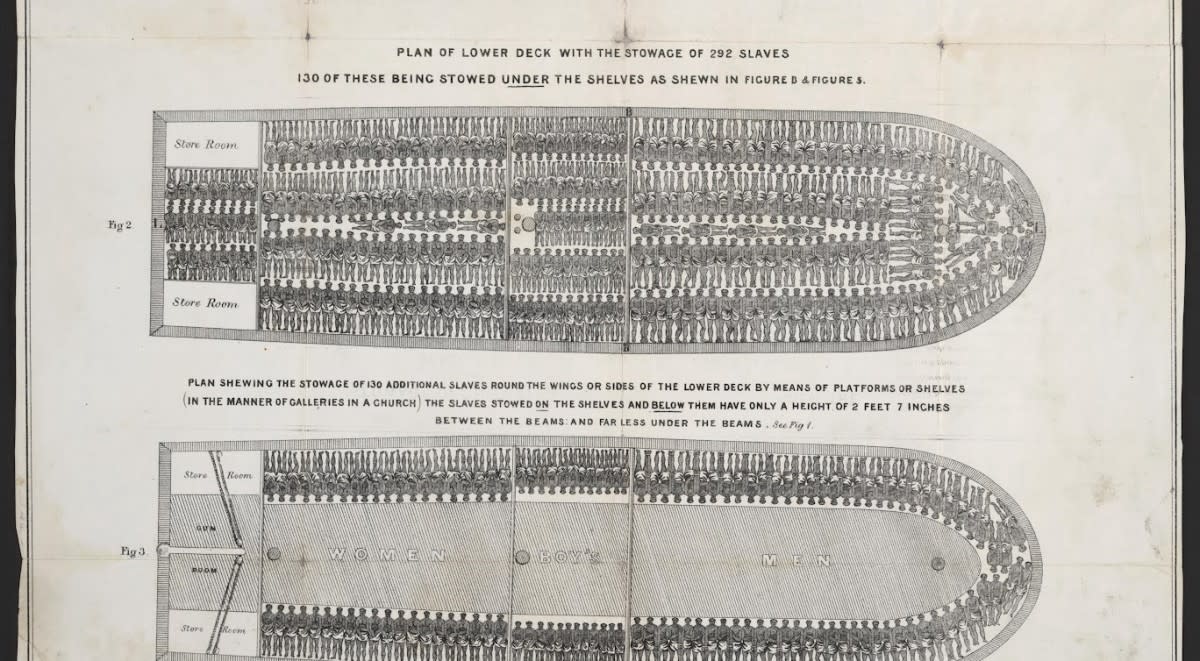
When I initially began reading Zong!, I was faced with the typical confusion that always seems to accompany this kind of poetry for me; the sparse wording and odd formatting were nothing short of disorienting, especially when combined with the complete lack of context I had with these poems. However, as I continued to read, these initial confusions only better lent themselves to the point the poetry was making.
In classrooms in the United States, the profound tragedies experienced by the Africans as they made their way to the new world are largely left glossed over and unexplored. Apathy regarding history is something that I find to be quite prevalent due to the way history is often taught, but Zong! does a wonderful job of filling these gaps. The feelings of disorientation, confusion, and altogether frustration I felt as I was trying to decipher these poems is a direct reflection of the confusions felt by the Africans that were transported to the “New World.” I have memories of learning about this in elementary school and how inhumanely these people were treated, but these realities failed to sink in whenI was just learning them from one angle. In Zong!, I felt as though I was transported into the mind of one of these individuals.
The elements of formatting utilized in these pieces mimic the unstructured form of natural thoughts; the confusion, frustration, and utter disorientation faced by these individuals are better felt in these poems. When reading this, it made me wonder about how history is taught in classrooms and its validity. I know that many history classes read novels to enrich their learning, but reading Zong! made me realize just how much of an asset this can be to students. Novels, poetry, and other creative works assist in the development of empathy as well as a deeper understanding of the events that occurred. In the current day, I can only see this as an enrichment to students’ learning in the United States.
Haitian Constitution
After close comparison of the Constitution of The United States, to the Imperial Constitution of Haiti of 1805, I felt that the Haitian constitution had great intentions for what they wanted to be the outcome of their country. Due to the language and content of the of the articles listed it is very clear that the Haitians were tired of French and imperialism influence within their country. The Haitians wanted to evoke drastic change in order to ensure that they would never be put in the position of being subordinate in their own country again, and even went as drastic as to say within their declaration of independence that they would chose death over not being allowed to have their freedom.
One of the articles that I would like to point out that caught my attention was Article 9. “Nobody deserves to be Haitian who is not a good father, a good son, a good husband, and, above all, a good soldier.” This article coupled with Article 10 “Fathers and Mothers cannot disinherit their children”, I feel that this shows that Haitians attempt to have a strong family dynamic along with their values. I think that these are important and attempt to shed light on their culture. Along with their strong family values this document also shows how they felt toward French imperialists and ways in which they could tackle their rule within this country.
The United States constitution does not have articles that discuss family values and I think that that definitely shows what we value as a country. It also shows what was important to us at the time of us creating this country. We were worried about foreign rule in a similar way Yes but our founding fathers were not being enslaved, and being stolen from. They were doing the enslaving and stealing and wrote the constitution so that those rights would not be taken away from them. There are similarities between the two constitutions but it shows that the warfare and imperialism within the country of Haiti was not the same as the United states reasoning for the creation of the country.
Smith’s “Declaration” Offers a New Context
The first thing that jumped out at me while reading Tracy K. Smith’s “Declaration” was the poem’s structure. I have never seen a poem have that spacing and style, so I decided to do some additional research and learned that “Declaration” is an example of erasure poetry. Meaning Smith used a pre-existing text and took out most of the original words to make something new. The pre-existing text in this case is the United States Declaration of Independence, and she eliminates most of the original words so that the Declaration of Independence can be viewed from a context that’s different from just the original colonies tearing away from Britain. This new context is able to use some of the significant themes the original text offers and apply them to different ideas. Smith is using her poem to illustrate the hypocrisy of the document because slavery was so prominent when it was written. The hypocrisy exists because the Declaration of Independence advocates for the inalienable rights of every person, yet slavery remained prominent for many years after the text was written.
Smith emphasizes the transitive verbs while leaving out the content making them incomplete in a sense. Some examples of this are “plundered our-,” “ravaged our-,” “destroyed the lives of our-,” “taking away our-,” and “abolishing our most valuable-.” In all of these examples there is no content provided, but it is because of this that we are able to look at the pre-existing text differently. Our new context fills in the content left out by Smith. All of those verbs fall in line with how people treated slaves during that time, and using the Declaration of Independence’s own words really highlights the contradiction. The writers of the old text failed to see their own faults in the society they created, and the examples “taken captive,” “on the high seas,” and “to bear” supports the idea that Smith wants us to see this contradiction. I believe Smith’s overall message is that we cannot excuse the hypocrisy of our history just because of how impactful the Declaration of Independence was in forming our country.
The Imperial Constitution of Haiti was Strange
The Haitian constitution was relatively very odd when compared to American constitution we are familiar with. What about its few articles was so off-putting, though?
The United States of America is a nation built upon a democratic republic and stimulated by its laissez-faire economy. This makes a land where power is more evenly spread. With this, it is often considered a place of freedom where opportunity sits everywhere. All one has to do is try. They may fail again and again, but they can always try. No matter what happens, an American has basic rights as an American that cannot be stripped. This is reflected in the constitution. The Imperial Constitution of Haiti portrays quite the contrary.
For starters, a Haitian who experiences bankruptcy will have their citizen suspend, per Article 8. Bankruptcy is a common affair in the competitive American market. While it is quite detrimental, it in no way makes a citizen un-American. Additionally, the Emperor directly selects his successor, per Article 26. The power dynamics of this constitution strongly contrast that of our own. The rest of their articles follow these trends.
The Haitian were on a different page.
Passing in Whiteness as Property
Within Harris’ article she describes her grandmother’s experience with passing. She describes how “anonymity was possible for a black person with white features” (276). Her grandmother’s ability to deceive the public’s evaluation of her immediate appearance allowed her to transcend some of the social constructs put in place at the time. Visual appearance created a societal separation between people of one race and another. This separation created opposition and animosity. To move past this social boundary some African Americans utilized their inherited “white” features to pass for white themselves. This allowed them to operate beyond the restrictions placed upon the social, cultural and racial group to which they had belonged.
In one of my prior courses, which was focused on Modernsim, we read Passing by Nella Larsen. This story describes the fictional experiences of black Americans in the early twentieth century who attempted to “pass” for white as well as the opposition to the practice. It detailed the internal struggles and fears associated with being caught within the lie. It really made the reader consider the turmoil that could happen within a person denying who they are and where they came from. This piece by Harris reminded me of this novel and made my experience reading those few lines on her grandmother’s life much more potent. I believe it also assisted me in trying to understand her perspective when writing this piece.
Presentation of Law in Two Constitutions
While reading, I was drawn to do a close reading comparison of the Haitian Constitution and the U.S. Constitution. I am currently in a Constitutional Law class so I couldn’t help but note the differences between the document from Haiti and here. Specifically, the biggest difference is in how the law is presented. One aspect of the United States Constitution that is frustrating in a Con Law class, but I found an appreciation for after reading the Haitian document, is the fluidity of it. The US Constitution is crafted in a vague way, especially in the Bill of Rights. I think that this vagueness and introduced elasticity is actually beneficial for the law. The law in the U.S. Constitution becomes malleable in a way that is still firm, but also open to interpretation. It opens it to changing times and beliefs so that it is not stuck in tradition, but able to move forward with the people. For example, the First Amendment says that “Congress shall make no law establishing religion, or prohibiting the free exercise thereof” which may seem specific, but is not. It brings up the questions of “what is a religion”, “can Congress allot tax money to religious organizations with secular aims”, etc. These are all questions that have answers that can change with the time because the law, in this case, is how it is interpreted. The Haitian Constitution does not have this flexible aspect. It seems that the clauses are very specific. Article Two says that “slavery is abolished forever”. This applies to the list of duties of the government as well. The U.S. Constitution lists vaguely again the roles of each branch of government, but the Haitian Constitution gets specific. Article 15 says that “The Empire is one and indivisible; its territory composed of six military divisions”. I should also note that there are some strangely vague parts like the article about the “good father”, but for the most part, I see this Constitution as something very specific. There is little room there for potential change. I am not here to argue that one is better than the other, but it is interesting that the U.S. Constitution opens the law to change, while the Haitian Constitution sets it more firmly.
 Literature and Law Spring 2020