The Banality of Evil

In Hannah Arendt’s Eichmann in Jerusalem, she explores the idea that someone can commit heinous atrocities without the heinous intentions behind them. She notes on several occasions on how ordinary Eichmann seemed on the stand, far from the antisemitic monster that the prosecution wished to paint him as. Yet, throughout the trial’s proceedings, Arendt truly defines what the “banality of evil” is.

The crimes committed by Eichmann and his compatriots may not have stemmed from anti-Semitic feelings, but that did not change the nature of the crime itself. Arendt describes this as a “…new type of criminal…” whose social circumstances and their removal from the reality of the situation make it nearly impossible for them to know the true atrocity of their actions, and this defines the true nature of a crime against humanity. Eichmann’s normalcy is what struck Arendt the most and what underscores her analysis of his guilt. His role in the Nazi’s Final Solution undoubtedly sent countless innocents to the gas chambers and yet he claimed to harbor no hatred for the Jewish people. His claim that any German could have taken his place was his main defense to the charges raised against him. Arendt counters the idea of “where all, or almost all are guilty, nobody is” by bringing up the case of Sodom and Gomorrah as well as the modern concept of collective guilt to emphasize the inexcusable nature of Eichmann’s actions. The judgement is ultimately not founded on the intentions of the criminal but on objectively what crime they committed and this is what the “banality of evil” truly is. The ability to commit evil deeds without evil intentions. She sees the circumstances surrounding Eichmann as irrelevant to the actions he objectively committed and thus he is condemned to death, not because he himself killed anybody but “no member of the human race, can be expected to want to share the Earth with you.” due to the heinous nature of the deeds carried out upon his order.
Eichmann and the power of the law

The most interesting part of Eichmann in Jerusalem to me was the question of what a court can do to “prove” guilt that is simply apparent. We all know that Eichmann committed atrocities the likes of which it is difficult to even comprehend, and he did them to human beings who had done nothing to deserve them. The court knows it, the reader knows it, Arendt knows it, and Eichmann knows it. The question thus becomes where a court’s authority runs out; obviously Eichmann’s argument that concentration camps were legal when he sent people to them is moot, but that raises many other ethical dilemmas. If one court can retroactively wipe the legitimacy of an entire legal system-one not its own, even-where is the line drawn between Israel condemning Hitler’s orders as bunk and Hitler himself stripping Jews of citizenship in order to kill them with no legal culpability under German laws of his day? Obviously the answer is that one of these is right and one is wrong-I can see that because I am human. But the question of what the law can do, being that the ideal of just law is its objectivity and its independence from human presumptions of right and wrong, is a lot murkier. 

The easy answer to this is that no human law will ever be able to make sense of such questions. Eichmann and every other complicit cog in the machine of the Holocaust will serve their due justice in due time, whether or not any judge on earth pronounces them guilty. This is a somewhat comforting answer, but it is not sufficient, particularly not for a newly formed Israel with lots of wrongs to attempt to right. Though I may believe Eichmann will face his rightful punishment from a higher power than any on earth, to let him go free of any attempted justice would not be right, either. This is where I believe Arendt loses her faith in the court, and part of why she refuses to not be critical of Ben-Gurion, the lawyer, the jury and the judges. Obviously she agreed with their eventual verdict, but I think she thought it was based on the wrong evidence. His feelings on Jewish people, his rank within the government, his insanity or lack thereof, none of those things matter. What he did was wrong because it was wrong, and I think finding a way to implement that legally is a lot easier said than done, but that was the challenge that Arendt, and I, would have liked to see them succeed in. 

Eichmann, a Tragic Hero?

Within Eichmann in Jerusalem, written by Hannah Arendt, we learn about the historic trial of war criminal, Adolf Eichmann. This novel is especially important because of the author’s depiction and narrative of Eichmann throughout his criminal trial. Within the epilogue in this prose we get to see very different illustrations of what kind of man Adolf was. Although one of a major organizers of the Holocaust, Eichmann is “terribly and terrifyingly normal” (276). Arendt continues through the entire book that although this man has made terrible decisions, she believes that he is not necessarily guilty of all of the crimes he is being charged with.

As a man whose job was to follow orders, Eichmann did that well. Although many of those orders was to contribute to the eradication of an entire race, Eichmann claims he is not AntiSemitic. Not racist or discriminatory, Eichmann was just a man doing his job. This understanding explains why the trials of this man could be covered in a novel over 290 pages long.

Although Arendt didn’t fully believe this man was the villain, she knew that “it would have been very comforting indeed to believe that Eichmann was a monster” (276). It seemed as if her heart wanted to believe this man and his story but her conscious stopped her. This can be seen in her final pages of the epilogue as she creates a fictional court ruling of why this man deserves to die. Although never directly stating Eichmann as guilty of helping the genocide, she talks about why this man is still guilty of supporting and standing by a cause that commenced the massacre of millions of Jewish people.

This depiction of Adolf is uncommon as almost everyone in the world can agree the architects of the Holocaust are some of the biggest monsters in the world. Personally, I don’t think the author put enough guilt on this man but I can see her point of discussion when she doesn’t think he is as bad as people see him as. this book and debate will flourish on through generations and hopefully even begin to spark new conversations in the future.

Eichmann’s punishment and justice

Reading “Eichmann in Jerusalem,” I immediately found myself wondering what the punishment for Eichmann would be since it is clear he is presumed to be, and is in fact, guilty of these crimes. As I continued reading about these crimes, I began to feel as if there is no punishment fit to his crimes, that no individual can ever receive such a severe punishment for suffering caused against an entire group of people. Ardent addresses these concerns. Some critics against the death penalty state, “The most common arguement was that Eichmann’s deeds defied the possiblity of human punshiment” (250). Others who attempted to address this gap between the severity of the crimes committed and the absence of an equivalent punishment propose more creative punishments such as “Eichmann should have spent the rest of his life at hard labor … (250). However, I feel this would not be fitting as it implies that law has the capability of closing the gap between justice and the crimes committed through various punishments, which I don’t believe is not possible in the case of Eichmann. 

Ardent also addresses those who called this punishment, “unimaginative,” which caught my eye reading because it is synonymous to banal, the essence, Ardent argues, of Eichmann’s evil. Ardent herself does not believe this is a reason to not inflict the death penalty (in her ideal version of the trial in her epilogue, she states he “must hang” (279)). In this framing, I do not think Ardent criticizes the punishment, but rather the trial and audience which failed to explore alternative manners of conduct in the courtroom, such as questioning Eichmann’s testimony of his lack or guilt, lack of hate, and lack of agency in his crimes. Reading this part of the book in particular, it seemed that critics looked for alternative punishments to close this gap between his crime and punishment, when Ardent perhaps wants them to embody this alternative approach to looking at things in trial and future for different ways of measuring justice. As a reader, it seems Ardent wants me to look at the development of the law different going forward, in manners such as the creation of “an international penal law” (273) reckoning with the fact that justice for the victims through punishment of the criminal may not ever be possible in the aftermath WW2 and could occur again.

The True Ideology on Trial in Eichmann in Jerusalem

The universality nature of court renders the accused to be required to not only be prosecuted, but also defended and judged. No matter the severity or feral the crime is, a human’s natural right allows he/she to have a trial (if it is fair is an entirely different debate). For Adolf Eichmann, the same is able to ring true, after being kidnapped from Argentina and taken to Israel to stand trial for his part in the eradication of the Jews during the Nazi regime. Yet, this Holocaust was not perpetrated by one man, it was a culmination of several factors all leading to the apex that is WWII, but the court does not see it in this way. For this day, the only factor/situation that matters is the lives that Adolf Eichmann directly affected and stole. On page 5 of Eichmann in Jerusalem Hannah Arendt notes that the surrounding factors of this mass extermination are simply inconsequential: “and that all the other questions of seemingly greater import—…be left in abeyance”(Arendt 5). Some of these mitigating factors that Arendt notes becoming obsolete are the roles of other nations, why did they allow this to happen, and above all why did this happen to the Jews. Arendt continues, noting that when it boils down to the true justice system, the only spotlight should be on Adolf Eichmann: “Justice insists on the importance of Adolf Eichmann”. This shows that the true “item” (for lack of a better word) on trial here is not the overall suffering of the Jewish race, not the overall racism and antisemitism, but the only think on trial here are the crimes were strictly committed at the hand Adolf Eichmann. For me, this brings up the case in Les Miserables whether stealing (a crime) a loaf a bread to feed your family (good deed), is truly a bad act. I believe that (following along the train of thought of Arendt) that this would be considered a crime because in this notion we are strictly looking at the act and not the mitigating factors surrounding it.

Eichmann in Jerusalem and Mental Illness

Throughout Hannah Arendt’s Eichmann in Jerusalem, the trial stands as a place where Adolf Eichmann’s stories are told and where past occurrences in his life have paved the road for undiagnosed mental illness. During the trial, the prosecution and defense battle between whether Eichmann was carrying out the actions and responses of a normal person or not. Even though Eichmann was deemed to be mentally healthy, there are multiple different instances where that is easily debatable. First of them being that he could not see the difference between following the inhumane Nazi law and being a moral human being. Eichmann was not known to harbor ill feelings towards the Jewish, “He ‘personally’ never had anything whatever against Jews; on the contrary he had plenty of ‘private reasons’ for not being a Jew hater” (Arendt 26). This further portrays and stems deeper into why Adolf Eichmann turned into a cruel concentration camp killer. Eichmann, from the beginning of his career, was seen as inferior compared to the rest. He was constantly working to raise his position, but continuously failed. This constant failure was ingrained into his mine and in my opinion, is the reason why Eichmann joined the Nazi party. He yearned to feel something other than defeat, so he turned into the tyrant and began to defeat others. His past years of inferiority shaped him into a power-hungry monster who would do anything to finally be the superior to an inferior group. The Nazi party took Eichmann when he was in a place of desperation to be accepted and made him feel welcome, which only further triggered his past failures, making him dangerously loyal. This resulted in Eichmann being an extremist. He would do anything for the Nazi party, which he deemed to be following the law, even if it meant he abandoned a moral belief system. Eichmann’s lonely early career forced him down a dark path, leaving him with a dangerous mental illness that left its mark on millions.

The Haitian Constitution

The Haitian Constitution is quite a historic document. This constitution was the 3rd one created in the world at this point in time and it was also created for the first black republic in the world. Comparing the Haitian Constitution to the constitution of the United States, there are some obvious differences. In comparison to the United States constitution, some of the articles of Haitain constitution were created, obviously submerged in the events of the time, and was in comparison more racially charged, instead of thinking towards the future. 

A few of the articles that are slightly odd and are reflective of Haiti’s feeling towards the French include Article 12, 13, and 14. Article 12 states that “No white person, of whatever nationality, shall set foot on this territory with the title of master or proprietor, nor in the future, acquire property here.” Being that slavery had been recently abolished, it would make sense for having this in the constitution at that time, however thinking  forward to the present, articles like this don’t apply to Haitian society today. Articles 13 and 14 essentially follow the same suit, and address race in the sense of a child coming from a Haitian man and white woman, is a Haitain citizen and the woman is allowed to stay as well.

Zong!: Layout & History

These poems threw me for a loop. I was not expecting the layout to look the way it did at all. His was the first time I have ever read something with this layout, so I was having to restart and reread many of these to make sure I was comprehending everything that was going on. It made my eyes hurt a little, which I wasn’t really a fan of, but the overall experience was interesting.

My first impression of the layout reminded me of the concept behind blackout poetry. I forgot who said it, but someone in class mentioned that it looked like some information or the rest of the sentence was missing, which would go along with my thought of blackout poetry. I also noticed that the layout didn’t stick to one format, if that makes sense. Some of the pages were set up in columns, diagonals, ovals, and some that didn’t have any specific shape, it just looked like a bunch of words on a page, more so than they already to.

I really liked the line that she kept repeating throughout the whole essay. “There is no telling this story; it must be told.” I like how she recognizes the fact that the events that took place during this time is something that she herself would not be able to fully understand and write about from her point of view. Even though none of this happened during her lifetime, and the information she gave was from a person that may or may not have existed, she still understood this was not her story to be told.

The content of the essay was really shocking. In school, you learn about slavery and its role in American history, but not a lot, if anything, about it from different countries around the world. We may be told that slavery did not just happen in America, but that’s about it. We don’t get any other information unless we do the research, which most likely won’t happen. So, it was intriguing to read about how slavery worked in another country.

Zong! Excerpts: Breaking Down the Chaos

My initial attempt at reading Zong! was a bit of a challenge for me, to say the least. Each poem made me feel forced out of my comfort zone in the worst way possible. My internal monologue resembled something along the lines of: why are the words like this, why are we reading this, what even is this? Trying to interpret each poem’s meaning felt like pulling teeth. But, as I read through NourbeSe Philip’s essay and read her poems a second time, I slowly began to understand the context of her pieces. My feelings of utter panic left and it became possible for me to break down each poem. Here are two of my interpretations:

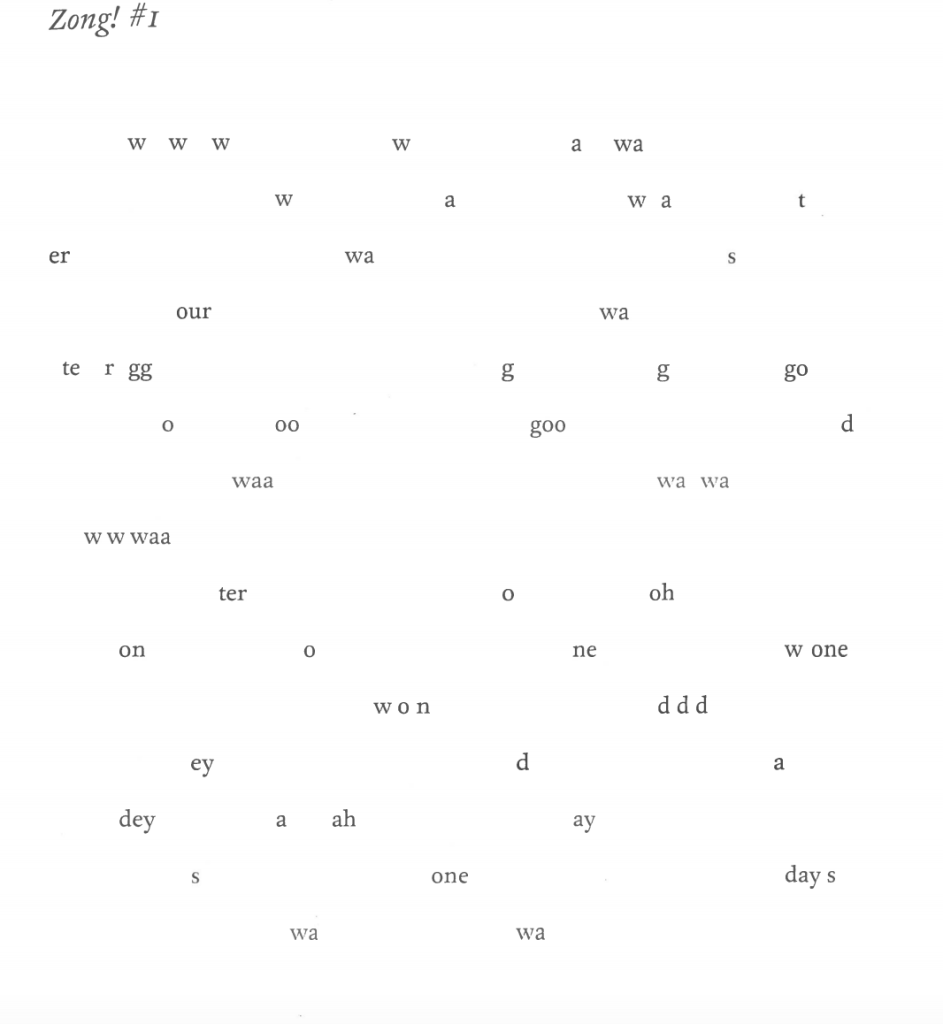
Zong! #1

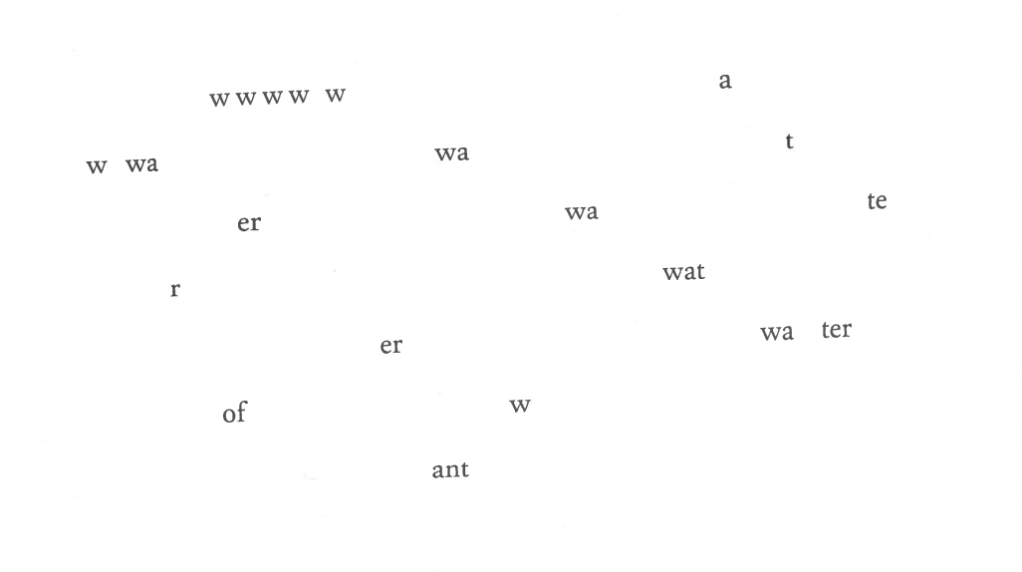
This is the first poem in the series and the most chaotic, in my opinion. On my first attempt at reading this, I lightly skimmed the poem as it seemed to be almost illegible. It meant nothing to me. During my second time around, things began to make more sense. I saw the poem in a completely different way. It is chaotic, but that was Philip’s exact intention. She attempts to mimic the gruesome and sad end that these slaves were forced to endure. I see this opening poem as a representation of the bodies of the enslaved people in the water as they drowned, those who suffered under dehydration, and those who starved to death. The way she writes, “w w w… w a t er,” sounds like one of the slaves trying to beg for water as he desperately dies of thirst. The way the letters are dispersed throughout the pages represent the bodies of helpless humans scattered throughout open water as they frantically drowned to their deaths.

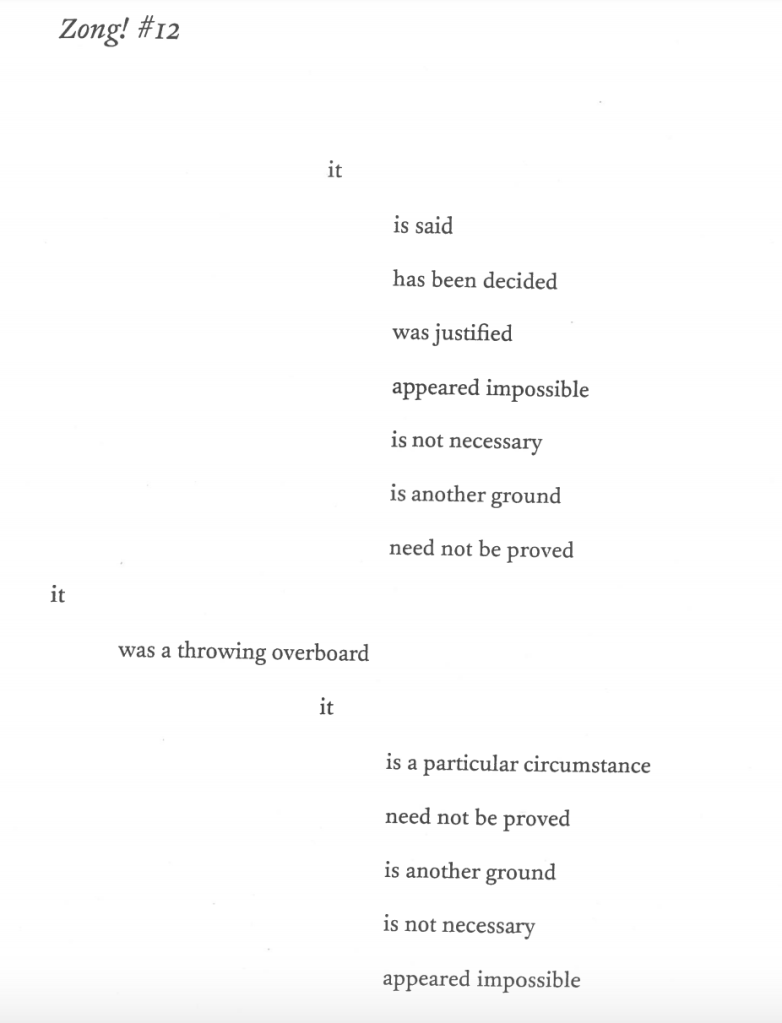
Zong! #12

Zong! #12 is my favorite poem in the series. The meaning of this poem seemed to jump right at me as I read it for the second time. The right column of the poem seems to be a conflict between morality and evilness as the captain ultimately comes to the decision to throw 150 slaves overboard. It may have been unnecessary, but the captain believed it was justified since he would earn more financial gains doing so. The left column featuring two lines gives the reality, “it was a throwing overboard.” Philip isolates this statement to emphasize that this is the bottom line: it was a throwing overboard which is neither justifiable nor necessary. The reason I liked this poem so much is because I felt that she brings in the obvious truth and exposes the wrongs of the mariners who overthrew the slaves, forcing them to drown. She speaks out against the tragedy and shows that it was by no means justifiable.

The poems of Zong! had a much different effect on me when I read them for a second time compared to the first time. The first time I read them, I went in blindly as I was unaware of any sort of context. After reading Philip’s essay, I was able to figure out the poems and see them from a completely different perspective. I felt emotionally moved while my spirits grew saddened as I read Philip’s creative interpretation of the suffering that these slaves were forced to go through.

I am curious to see how everyone else interpreted these poems. Did your brain process work similar to mine? Was it completely different reading the poems after learning about the tragedy in Philip’s essay?

Zong!: the irrepressible and the neverending

Prior to this reading, I had never heard of the Zong case. As I read the poems, I had no idea the context of what I was reading. I did not understand the full story until I read Philip’s essay, after I had already absorbed the poems. One thing I was struck by in her commentary on her work was the idea of telling a story through not telling it. In my case, she succeeded in this mission handily. I knew nothing of the story, but by the time I read the details, I was not surprised. The horror had already been whispered to me slowly through the poems. They translated to me the essentials of the situation, which, stripped of meaning, conveyed more through silence than noise. Water-frenzy-negroes-overboard-justice-escaped. My brain painted the rest of the picture, which had already been formed but was simply fleshed out through the revelations in Philip’s essay. In this there can be seen an element of subjectivity; the story can become anything the reader finds in it.


This is in part what I believe Philip means when she claims that in writing Zong! she implicates herself–simply by allowing the story any flexibility, she allows the atrocities to be overlooked. She exposes the dead for what they were–humans who deserved respect and dignity and life–by opening the history up for inspection, but in doing so she allows them to be abused once again. In turning them from property into people, she reveals the solemn truth: they were people the whole time, no matter what any law or judge said. So she is not only savior but warden. Putting a story like this into the world; one that reveals so much of the evil humanity has the potential for, yet also allows murder victims a space for remembrance, is a powerful statement but a dangerous one.


The other thing I believe Philip could mean when she talks about guilt in authoring this work is somewhat reminiscent of Derrida’s ideas. It could be debated that just by writing about an act so singularly and irrevocably violent, Philip furthers the worlds that allowed it to happen at all. In putting the words on paper, she claims some type of ownership over such a horrific event, giving herself the power to condemn or acquit, save or abandon. From this view, the poems of Zong! become performative acclamations, words that bring long dead atrocious acts and innocent souls back into the landscape of present-day, breathing life into them and encasing them in the written word, where they will rest forever. The struggle becomes that it is impossible to separate the two; the killer and the victim, the captain and the slave, the perpetrator and the victim. They must all await judgement together. This requires the most delicate sort of artistry from an author, and this is where I commend Philip in her performance more than anywhere else; she refuses to let the dead remain unheard, yet she neglects to give them her own voice, which would, in the end, only be yet another form of subjugation for them to endure.

Design a site like this with WordPress.com
Get started