
Is Paulina a Reliable Character in Death and the Maiden?

            From the beginning of Ariel Dorfman’s Death and the Maiden, it is clear that Paulina is a character that has experienced some sort of a traumatic situation in her past that has permanently altered her personality. This is evident from the first mention of Paulina in the play. When she hears a car approaching her house, she instantly becomes worrisome, “She hurriedly stands up, goes to the other room, looks out the window… goes to the sideboard, takes out a gun, stops when the motor is turned off and she hears Gerardo’s voice” (2). Dorfman makes Paulina’s harrowing past even more prominent when she and Gerardo discuss his offer from the President, “Nobody in the new government knows. I’m talking about the fact that we never made it public, as you never—as we never denounced the things that they—what they…” (6).

            Paulina then goes on to capture Roberto (15), a man whom her husband trusted enough to not only willingly offer him solace in their guest room for the night- but insisted that he stay there, as he declares “I won’t hear of it. You’re staying. You’re what? You’re half an hour away… Not another word” (13). This action, in accordance with Paulina’s paranoia and distressed nature, seems to strongly imply that Paulina may suffer from some form of mental instability; which Roberto does suggest claiming, “I do not know you, madam. I have never seen you before in my life. But I can tell you this: you are extremely ill, almost prototypically schizoid” (23). At which point I found myself agreeing with him and generally believing that Paulina was just unstable and becoming unhinged; which very well may have been Dorfman’s intentions in making Paulina seem to be of such unsound mind.

            The point at which I found myself beginning to agree with and fully believe Paulina’s accusation against Roberto came when she tells Gerardo that she recognizes more than just Roberto’s voice, “It’s not only the voice I recognize, Gerardo. I also recognize the skin. And the smell. Gerardo. I recognize his skin” (27). In situations such as Paulina’s, victims are taught to memorize as many details of their captors and surroundings as possible; therefore, it is highly plausible that Paulina could not mistake these aspects because they have been engrained into her memory. Furthermore, Paulina inserted slight variations in her story to Gerardo knowing that he would use that for Roberto’s confession; thus, proving that Roberto was, in fact, guilty- as he corrected all of her discrepancies (45). Not only does this prove Roberto’s guilt, it also proves Paulina’s reliability as a character.
Questions of Legality – Eichmann in Jerusalem

While reading Hannah Arendt’s Eichmann in Jerusalem, I had many questions racing through my mind. The Holocaust is arguably one of the most, if not the most, atrocious mass murder in human history, and it disgusts me to think that something of its scale actually occurred – and was able to occur for as long as it did. Nazis, like Eichmann, along with other individuals who played a role in orchestrating and carrying out such an awful event deserved to be held accountable for their crimes. However, as I was reading Arendt’s novel, I had many questions of legality come to mind.

One question being how a person can even be punished for committing a crime of this magnitude. The Holocaust resulted in the death of millions and affected millions more. Innocent men, women, and children were either put to death or worked to death in concentration camps; families and communities were torn apart. Frankly, I don’t believe there is any punishment that can be deemed as “fit” or “just” for the individuals who played a role in the execution of millions of people. In one section in the text, it is brought up that Eichmann should have “spent the rest of his life at hard labor” (pg 250), because of the torturous and forceful labor so many of those in the concentration camps had to endure. This makes me wonder if the justice system can even work in a situation like this, if there is any punishment that can be imposed matching the crime. The only punishment that comes close enough is, as Arendt discusses in the text, the death penalty; “he must hang” (pg 279).

As I continued reading I also thought about another aspect of legality in regards to Eichmann and other Nazi trials, and it is a question of jurisdiction. The Holocaust posed enormous legal issues for the international community. It was a crime against humanity, an entire population of people. So, who is actually responsible for holding the Nazis responsible? Eichmann’s trial takes place in an Israeli court and was orchestrated by the Israeli Prime Minister. Whereas the famous Nuremberg Trials were located in Germany. This made me wonder what gave certain regions the authority to put individuals on trial. (It could totally be an obvious answer but I’m just unsure).

Overall, Arendt does a great job commenting on Eichmann’s trial throughout her novel. She also brings up the phrase “banality of evil” in the text which I found very interesting to consider. It is another area of legality that is brought into question, which is individual intent/accountability. Eichmann claimed he may have committed these acts, but doesn’t have the terrible, anti-semitic mindset that was expected from someone like him. In fact, Arendt states that Eichmann was terrifyingly normal at his trial. Although Eichmann ends up being found guilty, it is interesting to consider this because intent is a crucial element to prove in the court of law.

Eichmann : A Man of Order?

Hannah Arendt makes it a point to explain how different Eichmann’s history of causing chaos compares to that of other high ranking Nazi Party members.  To begin with, Eichmann made a great effort to prove during his defense that he had no ill will towards the Jewish population.  He feels this way because he states he had a “Jewish mistress” from back in his time in Vienna. This marks a difference from other Nazi members whose history of anti-semitism was a key part in their role during the Final Solution.  Eichmann put a lot of emphasis on the fact that he harbored no hatred towards the Jewish people but was only following orders.  He also points out that he asked to be transferred to the front lines in order to get out of his murderous duty.  Eichmann even goes as far as to say that he would have murdered his own father had he been given the orders.

Now as we all know, Eichmann was prosecuted and found guilty on all charges presented and executed in Israel on June 1st, 1962.  Eichmann always felt he was being prosecuted for the wrong charges.  He stated he acted within the Nazi laws at the time and did not feel guilty before the law but did feel “guilty before God”.  Arendt later stresses how bragging was one of Eichmann’s vices.  During the last days of the war, Eichmann was reported to have said how accomplished he felt if he was headed to the grave.  “I will jump into my grave laughing, because the of the fact that I have the death of five million Jews on my conscience.”  That quote alone negates all of Eichmann’s defenses.  Arendt also brings up the issue with the charges brought against Eichmann.  Eichmann’s attitude during the case was that he alone never committed any murders.  This follows his feelings that he was only following orders, as he claimed he never hands on killed a single person.  The prosecution did point out that Eichmann at least once killed “a Jewish boy in Hungary.”  Eichmann always felt that he should have been charged with aiding “the annihilation of the Jews” and not genocide, crimes against humanity or war crimes.  Even after listening to Eichmann’s defenses, “the banality of evil”, will continue to be a heavy quote related to the colonels history.

The Banality of Evil

In Hannah Arendt’s Eichmann in Jerusalem, she explores the idea that someone can commit heinous atrocities without the heinous intentions behind them. She notes on several occasions on how ordinary Eichmann seemed on the stand, far from the antisemitic monster that the prosecution wished to paint him as. Yet, throughout the trial’s proceedings, Arendt truly defines what the “banality of evil” is.

The crimes committed by Eichmann and his compatriots may not have stemmed from anti-Semitic feelings, but that did not change the nature of the crime itself. Arendt describes this as a “…new type of criminal…” whose social circumstances and their removal from the reality of the situation make it nearly impossible for them to know the true atrocity of their actions, and this defines the true nature of a crime against humanity. Eichmann’s normalcy is what struck Arendt the most and what underscores her analysis of his guilt. His role in the Nazi’s Final Solution undoubtedly sent countless innocents to the gas chambers and yet he claimed to harbor no hatred for the Jewish people. His claim that any German could have taken his place was his main defense to the charges raised against him. Arendt counters the idea of “where all, or almost all are guilty, nobody is” by bringing up the case of Sodom and Gomorrah as well as the modern concept of collective guilt to emphasize the inexcusable nature of Eichmann’s actions. The judgement is ultimately not founded on the intentions of the criminal but on objectively what crime they committed and this is what the “banality of evil” truly is. The ability to commit evil deeds without evil intentions. She sees the circumstances surrounding Eichmann as irrelevant to the actions he objectively committed and thus he is condemned to death, not because he himself killed anybody but “no member of the human race, can be expected to want to share the Earth with you.” due to the heinous nature of the deeds carried out upon his order.

Why does Zong! look like that?

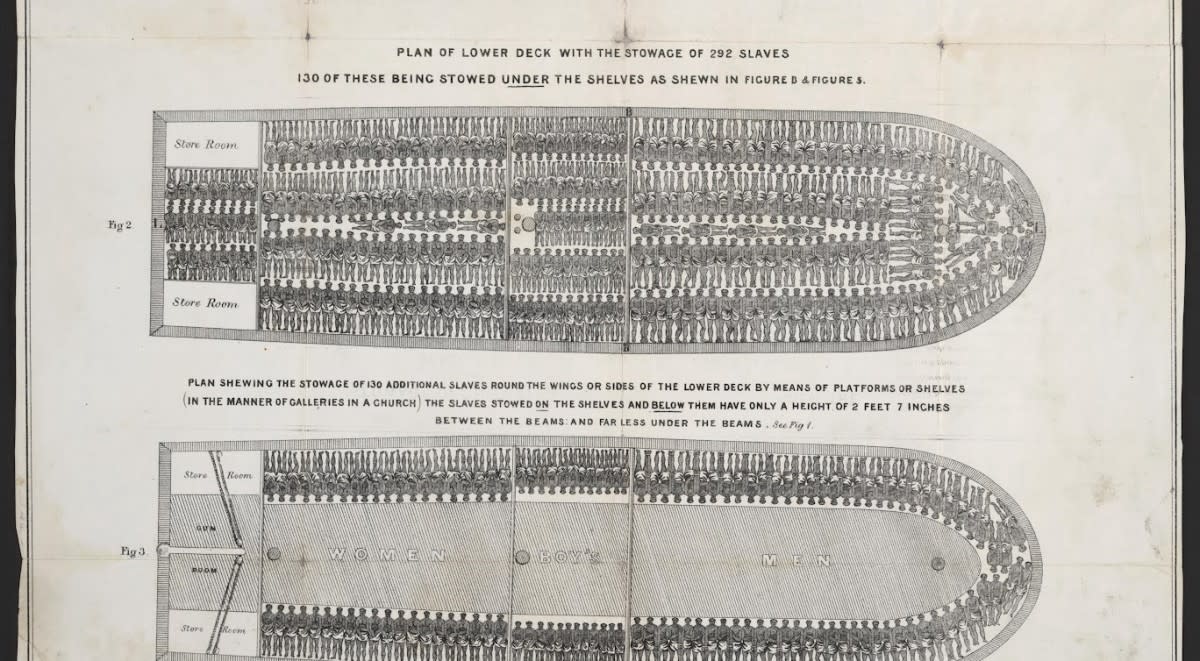
When I first opened the Zong! document I thought that I had broken my computer. At first glance, the structure is shocking. And like any other shocking element in literature, there’s a reason for it. I thought that the format was representative of the way a slave would have spoken. Coming from a foreign country and not knowing English / being deprived of the opportunity to become literate, a slave during this period might have spoken in sentence fragments like this. However, these “sentences” seem to be more chaotic. In the essay, Philip explains her clever tricks. Her approach was to choose words randomly, similar to the way that the slaves were chosen, which she describes as, “selected randomly then thrown together hoping that something would come of it.” Then I began to connect the dots between the words and the meaning. The words themselves represent each of the slaves. The large gaps of space represent the space that the slaves needed in the boat. Philip mentions that she tried to do research to get the names of the slaves on the boat and was devastated to find out that records were not kept of that. These humans were stripped of their names and therefore part of their story. Philip, in response, strips us of their story by “not telling it”. 

This is a story that needs to be told and Philip addresses that multiple times, but it is apparent that something is being held back. She says, “But this is a story that can only be told by not telling, and how am i to not tell the story has to be told.” This is where I get confused. She produced these poems in effort to tell the story. It is chaotic and mysterious, but it is not clear. So we know that she is not telling the story because in her eyes it cannot be told, but why, considering she explains the story in the essay?

Zong! & Apathy in History Classrooms

When I initially began reading Zong!, I was faced with the typical confusion that always seems to accompany this kind of poetry for me; the sparse wording and odd formatting were nothing short of disorienting, especially when combined with the complete lack of context I had with these poems. However, as I continued to read, these initial confusions only better lent themselves to the point the poetry was making. 

In classrooms in the United States, the profound tragedies experienced by the Africans as they made their way to the new world are largely left glossed over and unexplored. Apathy regarding history is something that I find to be quite prevalent due to the way history is often taught, but Zong! does a wonderful job of filling these gaps. The feelings of disorientation, confusion, and altogether frustration I felt as I was trying to decipher these poems is a direct reflection of the confusions felt by the Africans that were transported to the “New World.” I have memories of learning about this in elementary school and how inhumanely these people were treated, but these realities failed to sink in whenI was just learning them from one angle. In Zong!, I felt as though I was transported into the mind of one of these individuals. 

The elements of formatting utilized in these pieces mimic the unstructured form of natural thoughts; the confusion, frustration, and utter disorientation faced by these individuals are better felt in these poems. When reading this, it made me wonder about how history is taught in classrooms and its validity. I know that many history classes read novels to enrich their learning, but reading Zong! made me realize just how much of an asset this can be to students. Novels, poetry, and other creative works assist in the development of empathy as well as a deeper understanding of the events that occurred. In the current day, I can only see this as an enrichment to students’ learning in the United States.

Haitian Constitution

After close comparison of the Constitution of The United States, to the Imperial Constitution of Haiti of 1805, I felt that the Haitian constitution had great intentions for what they wanted to be the outcome of their country. Due to the language and content of the of the articles listed it is very clear that the Haitians were tired of French and imperialism influence within their country. The Haitians wanted to evoke drastic change in order to ensure that they would never be put in the position of being subordinate in their own country again, and even went as drastic as to say within their declaration of independence that they would chose death over not being allowed to have their freedom. 

One of the articles that I would like to point out that caught my attention was Article 9. “Nobody deserves to be Haitian who is not a good father, a good son, a good husband, and, above all, a good soldier.” This article coupled with Article 10 “Fathers and Mothers cannot disinherit their children”, I feel that this shows that Haitians attempt to have a strong family dynamic along with their values. I think that these are important and attempt to shed light on their culture. Along with their strong family values this document also shows how they felt toward French imperialists and ways in which they could tackle their rule within this country. 

The United States constitution does not have articles that discuss family values and I think that that definitely shows what we value as a country. It also shows what was important to us at the time of us creating this country. We were worried about foreign rule in a similar way Yes but our founding fathers were not being enslaved, and being stolen from. They were doing the enslaving and stealing and wrote the constitution so that those rights would not be taken away from them. There are similarities between the two constitutions but it shows that the warfare and imperialism within the country of Haiti was not the same as the United states reasoning for the creation of the country. 

Smith’s “Declaration” Offers a New Context

The first thing that jumped out at me while reading Tracy K. Smith’s “Declaration” was the poem’s structure. I have never seen a poem have that spacing and style, so I decided to do some additional research and learned that “Declaration” is an example of erasure poetry. Meaning Smith used a pre-existing text and took out most of the original words to make something new. The pre-existing text in this case is the United States Declaration of Independence, and she eliminates most of the original words so that the Declaration of Independence can be viewed from a context that’s different from just the original colonies tearing away from Britain. This new context is able to use some of the significant themes the original text offers and apply them to different ideas. Smith is using her poem to illustrate the hypocrisy of the document because slavery was so prominent when it was written. The hypocrisy exists because the Declaration of Independence advocates for the inalienable rights of every person, yet slavery remained prominent for many years after the text was written.

            Smith emphasizes the transitive verbs while leaving out the content making them incomplete in a sense. Some examples of this are “plundered our-,” “ravaged our-,” “destroyed the lives of our-,” “taking away our-,” and “abolishing our most valuable-.” In all of these examples there is no content provided, but it is because of this that we are able to look at the pre-existing text differently. Our new context fills in the content left out by Smith. All of those verbs fall in line with how people treated slaves during that time, and using the Declaration of Independence’s own words really highlights the contradiction. The writers of the old text failed to see their own faults in the society they created, and the examples “taken captive,” “on the high seas,” and “to bear” supports the idea that Smith wants us to see this contradiction. I believe Smith’s overall message is that we cannot excuse the hypocrisy of our history just because of how impactful the Declaration of Independence was in forming our country.

The Imperial Constitution of Haiti was Strange

The Haitian constitution was relatively very odd when compared to American constitution we are familiar with. What about its few articles was so off-putting, though?

The United States of America is a nation built upon a democratic republic and stimulated by its laissez-faire economy. This makes a land where power is more evenly spread. With this, it is often considered a place of freedom where opportunity sits everywhere. All one has to do is try. They may fail again and again, but they can always try. No matter what happens, an American has basic rights as an American that cannot be stripped. This is reflected in the constitution. The Imperial Constitution of Haiti portrays quite the contrary.

For starters, a Haitian who experiences bankruptcy will have their citizen suspend, per Article 8. Bankruptcy is a common affair in the competitive American market. While it is quite detrimental, it in no way makes a citizen un-American. Additionally, the Emperor directly selects his successor, per Article 26. The power dynamics of this constitution strongly contrast that of our own. The rest of their articles follow these trends.

The Haitian were on a different page.

The Property of Whiteness

In “The Property of Whiteness, Cheryl Harris, brings into discussion how the system of expansion and the transatlantic slave trade, was fueled by the overall growing incompetence to control the white labor force. This system created an institution that led to the permanent socioeconomic status of black people within this country as well as the dismantling of the entire Native American land and culture. To be white or the idea of “whiteness”, is to have the wealth and privilege to be able to go somewhere, take land, and people, and call them your property. 

White individuals within this country have stolen lands and people and used them for their own gain and profit and this is what Harris wants us to understand. This country was not based on the principles that everyone has rights but that only certain individuals have certain rights, and they may use those rights in order to subordinate an entire group of people. These “rights” are what has kept white people in a position of power for hundreds of years, because they made sure that the establishment of the law would work in their favor. 

The idea of Whiteness being property is to understand that being white, benefits you financially, socially, and overall in all aspects of life. But, the term of “Blackness” has zero positive connotation to it. To go out in society and seen as white, you have a clean slate, white a world full of opportunity at your feet whether you realize it or not, but to be black it means to constantly be aware of your surroundings, knowing that as soon as you leave your doorstep you will viewed differently and there is nothing you can do about it. To know that you will have to work 10 times as hard as your non poc counterparts but receive not nearly as much credit. 

Design a site like this with WordPress.com
Get started